HazAware
Smarter risk assessment and hazard reporting for high-risk worksites
Smarter risk assessment and hazard reporting for high-risk worksites
HazAware incorporates site procedures, past incidents, and lessons learned into pre-task risk assessments, ensuring known risks aren’t overlooked. It captures hazards as they’re identified and gives supervisors clear visibility and tracking — without disrupting existing site workflows.
HazAware incorporates site procedures, past incidents, and lessons learned into pre-task risk assessments, ensuring known risks aren’t overlooked. It captures hazards as they’re identified and gives supervisors clear visibility and tracking — without disrupting existing site workflows.
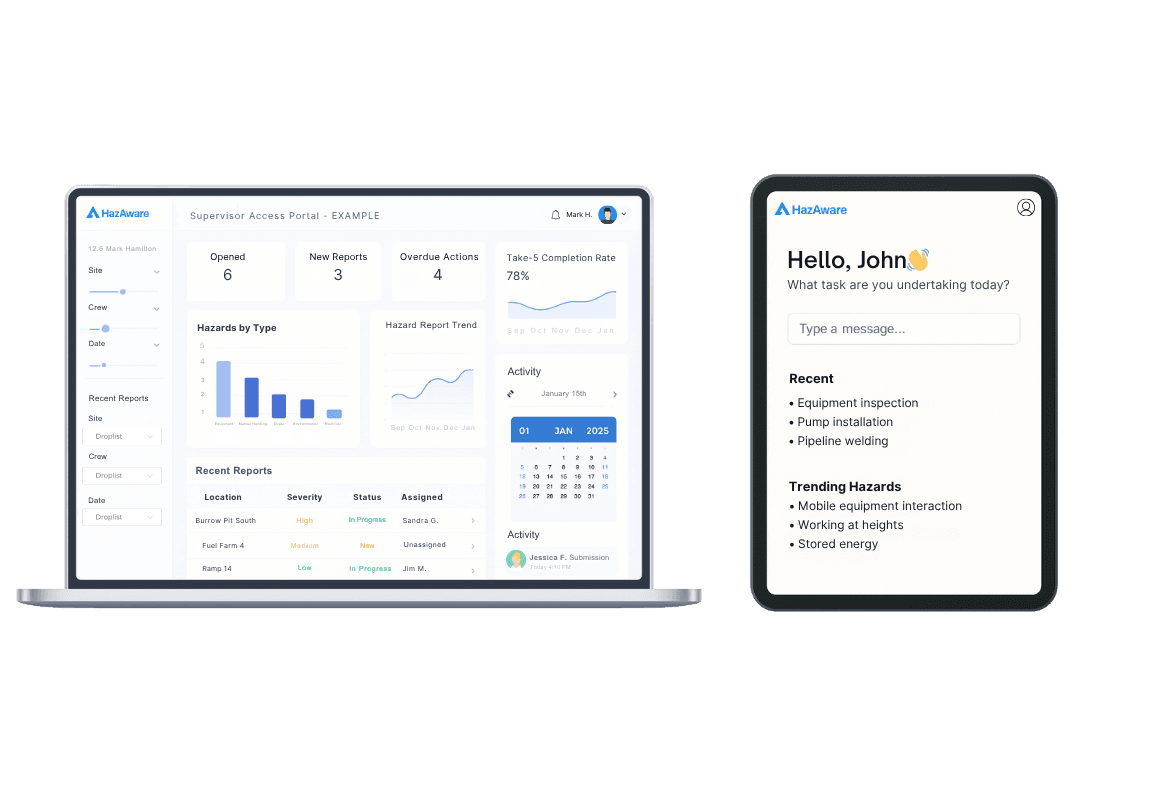
This image is an interface example only.
This image is an interface example only
This image is an interface example only.
Mining
Mining
Construction
Construction
Infastructure
Infastructure
Logistics
Logistics
Manufacturing
Manufacturing
Utilities
Utilities
Built For Industries Where Safety Can't Wait.
Built For Industries Where Safety Can't Wait.
Designed for high-risk industries, HazAware brings pre-task risk awareness, hazard reporting, and past incident learnings into the moment work begins.
How HazAware Reduces Risk on Site
How HazAware Reduces Risk on Site
A practical, pre-task approach that brings incident learnings into the moment work begins.
Identify risk before the task
Identify risk before the task
Workers complete a pre-task risk assessment relevant to the task and location — quickly, and with minimal interaction.
Learn from real site history
Learn from real site history
Relevant past hazards, incidents, and near misses are recalled during pre-task planning — so known risks aren’t forgotten.
Act before incidents repeat
Act before incidents repeat
Supervisors gain early visibility into emerging risks and repeated issues — without chasing paperwork or spreadsheets.
Identify risk before the task
Workers complete a pre-task risk assessment relevant to the task and location — quickly, and with minimal interaction.
Learn from real site history
Relevant past hazards, incidents, and near misses are recalled during pre-task planning — so known risks aren’t forgotten.
Act before incidents repeat
Supervisors gain early visibility into emerging risks and repeated issues — without chasing paperwork or spreadsheets.
The Limitations of Traditional Safety Systems
The Limitations of Traditional Safety Systems
Paper-based risk assessments (Take 5s, JSAs, SLAM, BSAFE) are often rushed, skipped, or completed after work has already started
Hazards are typically logged after incidents occur — not proactively before work begins
Past incidents, near misses, and relevant site procedures are often forgotten or not surfaced during pre-task planning — meaning known hazards aren’t considered at the point of work.
Safety data is scattered across paperwork and spreadsheets, limiting visibility and trend analysis
A Smarter, Proactive Approach to
Site Safety
Task-based risk assessments completed before work starts, aligned to the job and location
Past incidents, near-misses, and site procedures are used to surface relevant risks during pre-task planning
Task-specific hazard prompts are provided before work begins — similar to having an experienced supervisor review the task
Real-time visibility for supervisors and safety teams — without chasing paperwork or spreadsheets
Task-based risk assessments completed before work starts, aligned to the job and location
AI learns from past incidents, near-misses, and site procedures to highlight recurring risks
AI provides real-time, task-specific hazard suggestions — similar to having an experienced supervisor on site
Real-time visibility for supervisors and safety teams — without chasing paperwork or spreadsheets
A Smarter, Proactive Approach to Site Safety
The Limitations of Traditional Safety Systems
The Limitations of Traditional Safety Systems
Paper-based risk assessments (Take 5s, JSAs, SLAM, BSAFE) are often rushed, skipped, or completed after work has already started
Hazards are typically logged after incidents occur — not proactively before work begins
Safety data is scattered across paperwork and spreadsheets, limiting visibility and trend analysis
The Limitations of Traditional Safety Systems
Paper-based risk assessments (Take 5s, JSAs, SLAM, BSAFE) are often rushed, skipped, or completed after work has already started
Hazards are typically logged after incidents occur — not proactively before work begins
Safety data is scattered across paperwork and spreadsheets, limiting visibility and trend analysis
Intelligent Safety Management for Modern Worksites
HazAware Features
The Limitations of Traditional Safety Systems
Paper-based risk assessments (Take 5s, JSAs, SLAM, BSAFE) are often rushed, skipped, or completed after work has already started
Hazards are typically logged after incidents occur — not proactively before work begins
Past incidents, near misses, and relevant site procedures are often forgotten or not surfaced during pre-task planning — meaning known hazards aren’t considered at the point of work.
Safety data is scattered across paperwork and spreadsheets, limiting visibility and trend analysis
Task-based risk assessments completed before work starts, aligned to the job and location
Past incidents, near-misses, and site procedures are used to surface relevant risks during pre-task planning
Task-specific hazard prompts are provided before work begins — similar to having an experienced supervisor review the task
Real-time visibility for supervisors and safety teams — without chasing paperwork or spreadsheets
A Smarter, Proactive Approach to Site Safety
Intelligent Safety Management for Modern Worksites
HazAware Features
Spot hazards before they become incidents
Incident-Based Hazard Prompts
HazAware uses AI to review site reports, task details, and historical incidents, surfacing relevant known hazards and lessons learned before work begins. It then provides task-specific hazard prompts and control considerations — helping crews think through the right controls early, not after something goes wrong.
Think of it like having access to the experience of past incidents and lessons learned at the point of task planning.

The Limitations of Traditional Safety Systems
Paper-based risk assessments (Take 5s, JSAs, SLAM, BSAFE) are often rushed, skipped, or completed after work has already started
Hazards are typically logged after incidents occur — not proactively before work begins
Past incidents, near misses, and relevant site procedures are often forgotten or not surfaced during pre-task planning — meaning known hazards aren’t considered at the point of work.
Safety data is scattered across paperwork and spreadsheets, limiting visibility and trend analysis
Task-based risk assessments completed before work starts, aligned to the job and location
Past incidents, near-misses, and site procedures are used to surface relevant risks during pre-task planning
Task-specific hazard prompts are provided before work begins — similar to having an experienced supervisor review the task
Real-time visibility for supervisors and safety teams — without chasing paperwork or spreadsheets
A Smarter, Proactive Approach to Site Safety
The Limitations of Traditional Safety Systems
Paper-based risk assessments (Take 5s, JSAs, SLAM, BSAFE) are often rushed, skipped, or completed after work has already started
Hazards are typically logged after incidents occur — not proactively before work begins
Past incidents, near misses, and relevant site procedures are often forgotten or not surfaced during pre-task planning — meaning known hazards aren’t considered at the point of work.
Safety data is scattered across paperwork and spreadsheets, limiting visibility and trend analysis
A Smarter, Proactive Approach to
Site Safety
Task-based risk assessments completed before work starts, aligned to the job and location
Past incidents, near-misses, and site procedures are used to surface relevant risks during pre-task planning
Task-specific hazard prompts are provided before work begins — similar to having an experienced supervisor review the task
Real-time visibility for supervisors and safety teams — without chasing paperwork or spreadsheets
Intelligent Safety Management for Modern Worksites
HazAware Features
Report hazards in seconds — not paperwork
Simplified Mobile / Tablet Reporting
HazAware makes safety reporting effortless on mobile and tablet. Workers can log hazards on the spot, attach photos, and auto-categorise risks using voice or text — all in seconds.
No paper. No delays. No chasing forms.

Spot hazards before they become incidents
Incident-Based Hazard Prompts
Incident-Based Hazard Prompts
HazAware uses AI to review site reports, task details, and historical incidents, surfacing relevant known hazards and lessons learned before work begins. It then provides task-specific hazard prompts and control considerations — helping crews think through the right controls early, not after something goes wrong.
Think of it like having access to the experience of past incidents and lessons learned at the point of task planning.
Report hazards in seconds — not paperwork
Spot hazards before they become incidents
Simplified Mobile / Tablet Reporting
Incident-Based Hazard Prompts
HazAware makes safety reporting effortless on mobile and tablet. Workers can log hazards on the spot, attach photos, and auto-categorise risks using voice or text — all in seconds.
No paper. No delays. No chasing forms.
HazAware uses AI to review site reports, task details, and historical incidents, surfacing relevant known hazards and lessons learned before work begins. It then provides task-specific hazard prompts and control considerations — helping crews think through the right controls early, not after something goes wrong.
Think of it like having access to the experience of past incidents and lessons learned at the point of task planning.

Built for the real world — not perfect signal
Built for the real world — not perfect signal
Offline Mode & Sync
Offline Mode & Sync
No reception? No problem. HazAware works fully offline, allowing crews to complete risk assessments and log hazards anywhere on site.
Everything syncs automatically once back online — so nothing is missed and no one has to re-enter data.
No reception? No problem. HazAware works fully offline, allowing crews to complete risk assessments and log hazards anywhere on site.
Everything syncs automatically once back online — so nothing is missed and no one has to re-enter data.
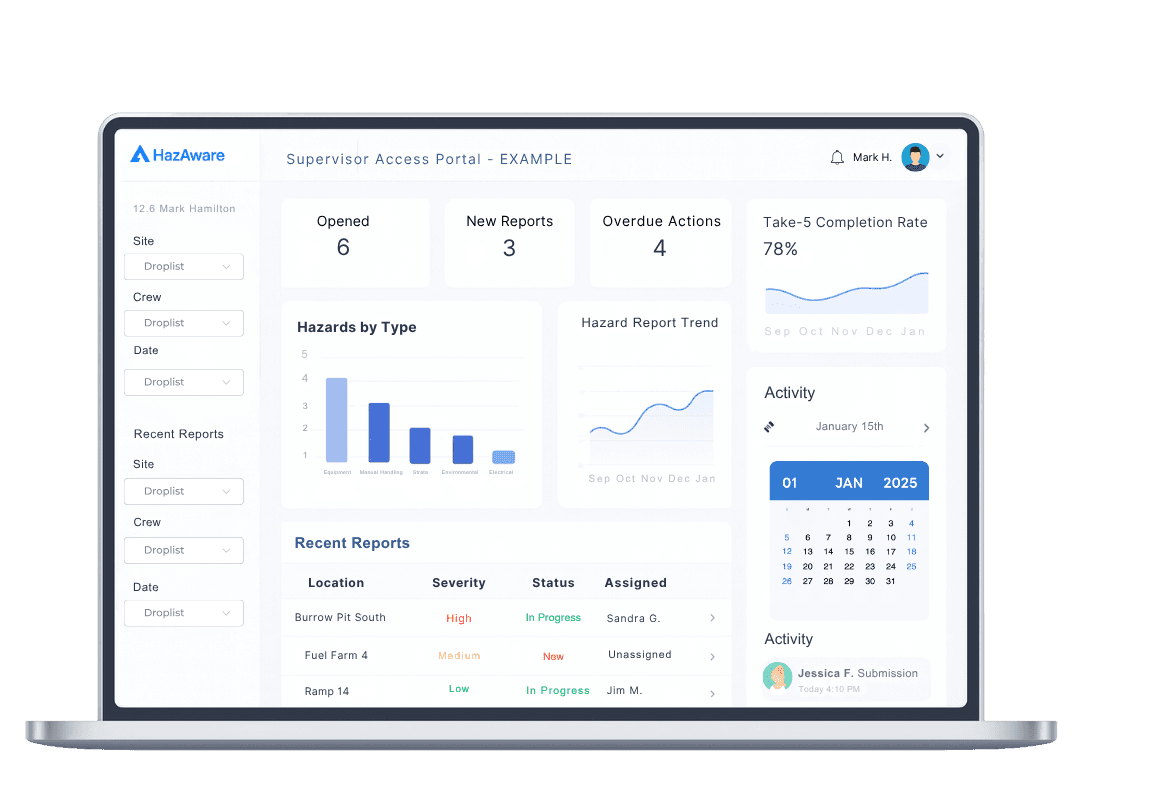
Supervisors get clear visibility into hazard types, locations, and frequency across site — before issues escalate.
Supervisors get clear visibility into hazard types, locations, and frequency across site — before issues escalate.
Supervisor Dashboard & Safety Trends
Supervisor Dashboard & Safety Trends
HazAware uses AI to review reported hazards, near misses, and incidents over time, surfacing recurring risks and areas of repeated exposure across site.
Supervisors can track close-outs, identify where controls may be breaking down, and focus safety improvements where they matter most — without digging through paperwork or spreadsheets.
HazAware uses AI to review reported hazards, near misses, and incidents over time, surfacing recurring risks and areas of repeated exposure across site.
Supervisors can track close-outs, identify where controls may be breaking down, and focus safety improvements where they matter most — without digging through paperwork or spreadsheets.

Frequently Asked Questions
Want to make your job site safer today?
Join the HazAware Pilot.
Want to make your job site safer today?Join the HazAware Pilot.
Be among the first sites to trial HazAware’s pre-task risk and hazard reporting workflow.
Get early access, provide real site feedback, and see how incident learnings, hazard prompts, and supervisor visibility can be brought into daily work — without disrupting existing site processes.
Limited pilot availability for selected sites.
Be among the first sites to trial HazAware’s pre-task risk and hazard reporting workflow.
Get early access, provide real site feedback, and see how incident learnings, hazard prompts, and supervisor visibility can be brought into daily work — without disrupting existing site processes.
Limited pilot availability for selected sites.
HazAware
Smarter Safety Starts with Awareness.